
The OJ Simpson saga was a unique American moment. 3 decades on, we're still wondering what it means
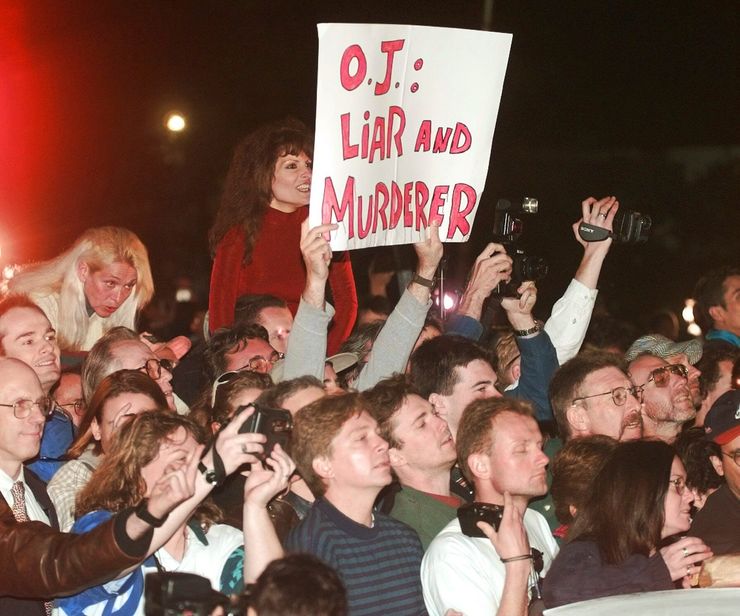
Apr 11, 2024
O.J. Simpson’s death came almost exactly three decades after the murders that changed his reputation from football hero to suspect and cultural touchstone
NEW YORK (AP) — A dog’s plaintive wail. A courtroom couplet-turned-cultural catchphrase about gloves. A judge and attorneys who became media darlings and villains. A
slightly bewildered houseguest
elevated, briefly, into a slightly bewildered celebrity. Troublingquestions about race
that echo still. The beginning of the Kardashian dynasty. Anepic slow-motion highway chase.
And, lest we forget, two peoplewhose lives ended brutally.
And a nation watched — a nation far different than today's, where the ravenousness for reality television has multiplied. The spectator mentality of those jumbled days in 1994 and 1995, then novel, has since become an intrinsic part of the American fabric. Smack at the center of the national conversation was
O.J. Simpson,
one of the most curious cultural figures of recent U.S. history.Simpson's death Wednesday,
almost exactly three decades after the killings that changed his reputation from football hero to suspect, summoned remembrances of an odd moment in time — no, let's call it what it was, which was deeply weird — in which a smartphone-less country craned its neck toward clunky TVs to watch a Ford Bronco inch its way along a California freeway.“It was an incredible moment in American history,” said Wolf Blitzer, anchoring coverage of Simpson's death Thursday on CNN. What made it so — beyond, of course, tabloid culture and the fundamental news value of such a famous person accused in such brutal killings?
THE SAGA ANTICIPATED 21ST CENTURY MEDIA
In an era when the internet as we know it was still being born, when “platform” was still just a place to board a train, Simpson was a unique breed of celebrity. He was truly transmedia, a harbinger of the digital age — a walking, talking crossover story for multiple audiences.
He was sports — the very pinnacle of football excellence. He was stardom, not only for his athletic prowess but for his
Hertz-hawking run through airports
on TV and his acting in movies like “The Naked Gun." He embodied societal questions about race, class and money long before Nicole Brown Simpson and Ronald Goldman were stabbed to death on June 12, 1994.Then came the saga, beginning with the killings and
ending — only technically — in a Los Angeles courtroom
more than a year later. The most epic of American novels had nothing on this period of the mid-1990s. Americans watched. Americans talked about watching. Americans debated. Americans judged. And Americans watched some more.The generations-old chasm between white Americans and Black Americans was not helped by Time magazine's decision to tactically darken Simpson's mugshot on its cover for dramatic — and, many said, racist — effect. For those who lived through that period, it's hard to remember much in the public sphere that wasn't crowded out by the O.J. storyline and its many components, including the subsequent civil trial that found Simpson liable for the deaths. One newspaper even ran a series of possible endings to the storyline, written by mystery novelists.
Sure, people were saying different things. But it was, inarguably, a national conversation.
The nation — and its media — are far more fragmented now. Rarely these days do Americans gather around the virtual campfire for a common experience; instead, small brush fires draw niche crowds in virtual corners for equally intense, but smaller, common experiences. This week's eclipse was a rare exception.
In 1994, everyday real-time, wall-to-wall coverage was still emerging. Sure, we had Walter Cronkite during
the Kennedy assassination
and again duringthe chaotic 1968 Democratic National Convention.
And the first Gulf War in 1991 firmly cemented live-TV expectations. But coverage of the Bronco chase and the trial fed the appetite in a way no other event did. Even now, such universal viewership is rare.“The media we consume is much more diffuse now. It’s so rare that we’re all glued to the same spectacle,” said Danielle Lindemann, author of the 2022 book “True Story: What Reality TV Says About Us.”
“In 1994 we were watching our television sets and following along with news coverage," Lindemann, a professor of sociology at Lehigh University, said in an email. “But there wasn’t that parallel discourse happening via social media.”
CONNECTIONS BETWEEN THEN AND NOW
The connections between the Simpson saga and today aren't hard to find.
Judges and lawyers in high-profile cases are now regular fodder for the spotlight. One of Simpson's attorneys, Robert Kardashian, paved the way
for the next generation of his family
to change the very face of how celebrity operates. A local Los Angeles TV reporter who covered the case,Harvey Levin, went on to establish TMZ,
a luridly foundational pillar of modern multiplatform celebrity coverage — and the outlet that broke the news of Simpson's death.And of course, as with so many American stories,
there is the question of race.
Simpson's acquittal on murder charges revealed a fundamental fault line: Some Black people welcomed the verdict, while many white people were in disbelief. Simpson probably confused matters more over the years by saying, famously, “I'm not Black. I'm O.J.” But for many Black Americans who felt their interactions with police and the courts had produced unjust results, the acquittal was a notable exception.
“There was a sense that it's only justice for a rich Black man to get off when a rich white man would,” said John Baick, a professor of history at Western New England University.
Three decades on, that conversation isn't over — he's certainly still discussing it with students. On Thursday, Baick invoked Simpson to talk about race, fame and wealth in class; only after it ended did he find out his subject had died.
A generation has passed since these events were fresh. And after thousands of hours of video, millions of written words and countless talking heads weighing in, the O.J. Simpson case stands as two things: an American moment like no other, and an interlude that contained so much of what American culture is and was becoming.
From the old, weird America, it got the obsession with violent true crime and its quirky cast of film noir villains and heroes, not to mention the tragedy and the whodunit. And it was a teaser trailer of the emerging, fragmenting internet culture that would, in a few years, give us smartphones, social media, reality-TV saturation and live coverage of just about everything.
Was it, as so many said so loudly, “the trial of the century”? That's subjective. But any culture is made up of small bits, and the Simpson case left many of those in its wake. This much is incontrovertibly true: After the slow-speed chase, American media culture got a whole lot faster really quickly. So fast, in fact, that many of the central questions around the case — about race, justice and how we consume murder and misery as just another set of consumer products — linger unanswered.
“Where does this fit in? What do Americans think about this now?” Baick wonders. ”What you think about O.J. Simpson might be a litmus test for a long time still.”
___
Ted Anthony, director of new storytelling and newsroom innovation for The Associated Press, has been writing about American culture since 1990 and oversees AP's coverage of trends and culture. Follow him at
http://twitter.com/anthonyted
.More News

People Are Divided After Matt Damon Called Out A Major Issue With How The Oscars Are Decided, And I Think He’s Got A Point
Some of you aren't gonna like this... View Entire Post ›

How the Baltics Are Juggling a Boom in Foreign Productions Like ‘Woman Unknown’ With a Lack of Public Funds
Mid-October, Estonia’s long-awaited next-gen film studio complex Ida Hub, in the country’s eastern region, finally opened for business, and industry guests at Tallinn’s Black Nights Film Festival are invited to tour the facilities Nov. 21-22. As stressed by Edith Sepp, head of the Estonian Film Institute, the country’s brand-new studio powerhouse, twinned with the Tallinnfilm […]

Eurovision Song Contest Asia: What to Know
South Korea, the Philippines and nine other countries will compete in the Asian edition of Europe’s high-camp original song competition.

Netflix Is Dropping A Russell Brand Documentary Today, And People Are Saying The Exact Same Thing
"Then maybe take Brand's stand-up show down lads???" View Entire Post ›

Russell Brand Faces Sexual Misconduct Claims From Six More Women After Rape Sentencing
Six more women have accused Russell Brand of sexual misconduct in a new investigation by The Times and The Sunday Times, the newspapers whose earlier reporting on the comedian features in Netflix’s just-unveiled documentary “Russell Brand: Open Secret.” The accounts were published days after Brand was jailed for rape and sexual assault. The papers could […]
Jessica Chastain breezes through a pulpy, country-fried Taken in Heartland
Skip the singing in Heartland, but enjoy Jessica Chastain's bratty performance as the avenging aunt of a missing country star.

‘Heartland’ Review: Jessica Chastain Rocks a Stetson and a Swagger for a Soapy Nashville Noir
Misty Jones keeps her Grammy in the fridge, alongside a near-empty Tupperware of chicken broth and, well, not a whole lot else: A former country superstar turned burnt-out rural hermit, she more or less lives off what once was, but her memories don’t exactly nourish her. Peculiar details like these enliven “Heartland,” a missing-person mystery […]

Tony Award Winner Lois Smith Joins Colin West’s ‘Outside of Cleveland’: ‘She’s an Icon’ (EXCLUSIVE)
Tony award winner Lois Smith has joined the cast of Colin West’s upcoming feature “Outside of Cleveland.” Smith’s first on-screen role was in 1955 opposite James Dean in “East of Eden.” She has appeared in such films as “Five Easy Pieces,” “Twister,” “Minority Report,” “Dead Man Walking,” “Ladybird” and “The French Dispatch.” In 2017, Smith […]

Sharon Osbourne reacts to Russell Brand's sentencing: 'You play, you pay'
Sharon Osbourne reacts to Russell Brand's sentencing: 'You play, you pay'Sharon Osbourne is expressing her opinion on Russell Brand’s sexual assault and rape convictions.During the latest episode of The Osbournes podcast, the 74-year-old TV personality stated that the disgraced comedian "must...

LISA’s ‘Viva La Lisa’ Set List Revealed After Opening Night of Las Vegas Residency!
Lisa is kicking off her new residency! The 29-year-old Blackpink singer and actress, who you may recognize from The White […] The post LISA’s ‘Viva La Lisa’ Set List Revealed After Opening Night of Las Vegas Residency! appeared first on Just Jared - Celebrity News, Entertainment News & Photos.

Blink-182 to make Download debut as 2027 festival headliners
Evanescence and Bring Me The Horizon will also top the bill at the rock and metal festival.

John Travolta reveals how he knows late wife Kelly Preston 'did well'
John Travolta reveals how he knows late wife Kelly Preston 'did well'John Travolta is remembering his late wife, Kelly Preston, while admitting that he is proud of her for raising his kids "well."The 72-year-old actor and director recently caught up with Extra TV and opened up about how much he...